How to Choose a Custom Software Development Company: A Complete Guide for Businesses (2026)
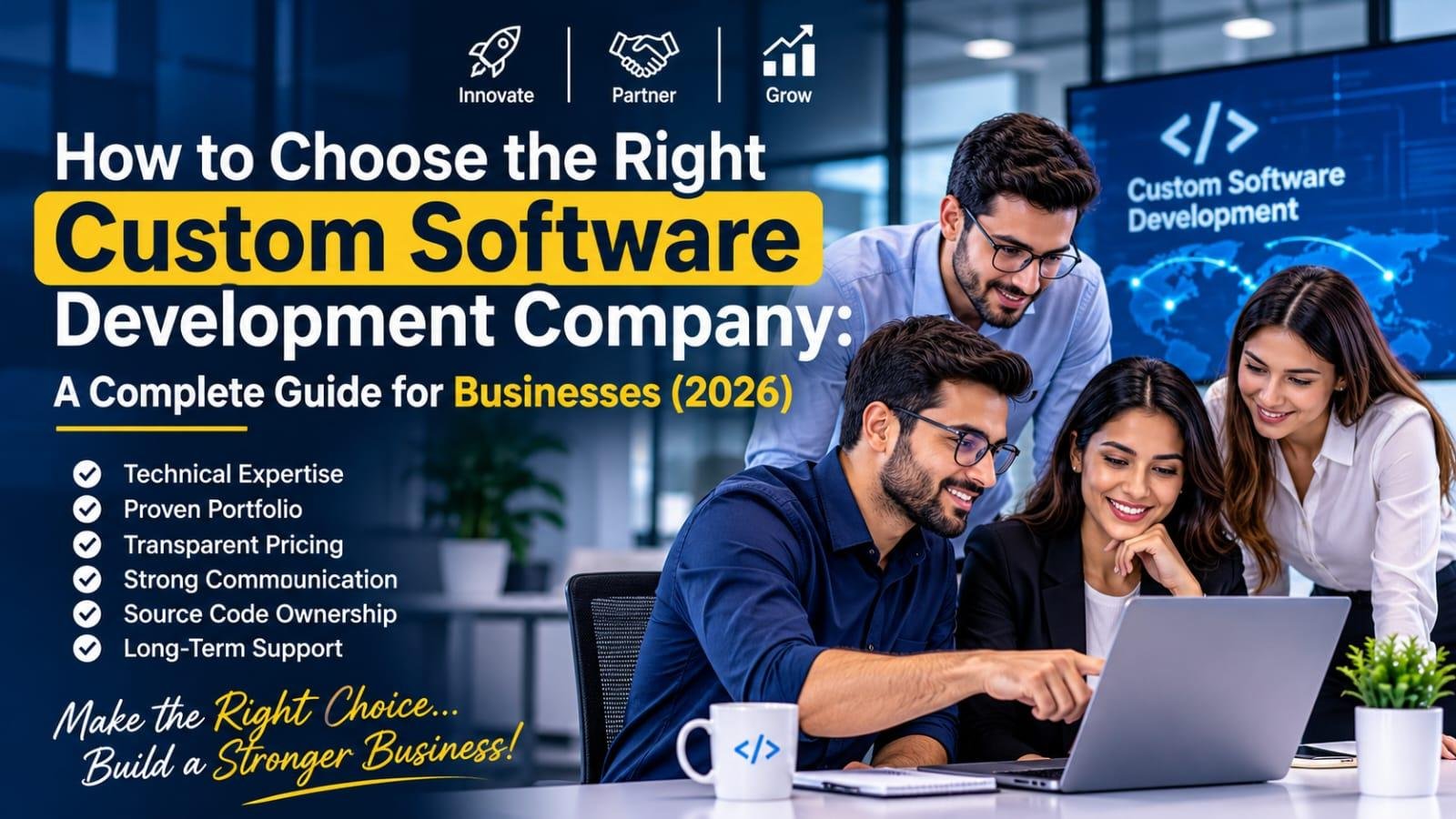
🌐 How to Choose a Custom Software Development Company: A Complete Guide for Businesses (2026)
Choosing the right custom software development company is one of the most important decisions for a business planning to build a digital product, automate operations, or improve its existing technology. The right development partner can help you reduce operational costs, improve productivity, scale your business, and create a competitive advantage.
However, choosing the wrong company can result in missed deadlines, unexpected costs, poor-quality software, security risks, and long-term maintenance problems.
With hundreds of software development agencies and freelancers available worldwide, how do you identify a reliable technology partner?
In this guide, we will explain what to look for when hiring a custom software development company, how to evaluate technical expertise, what questions to ask before signing a contract, and how to protect your investment.
1. Define Your Business Requirements Before Hiring
Before contacting a software development company, clearly define what you want to build and why you need it.
Many projects fail because businesses start development without understanding their requirements, goals, or priorities.
Start by identifying:
- The business problem your software needs to solve
- Your target users and customer requirements
- The essential features and functionalities
- Your expected project timeline
- Your budget range
- Whether you need a web application, mobile app, SaaS platform, CRM, ERP, or automation solution
You do not need a complete technical specification before contacting a development team. However, having a clear business objective will help developers understand your vision and recommend the right solution.
A reliable development company should help convert your business requirements into a practical technical roadmap.
2. Evaluate the Company's Technical Expertise
Not every software development company specializes in the same technologies or project types.
Some companies focus on websites, while others develop enterprise applications, SaaS platforms, mobile applications, API integrations, and complex business management systems.
Before hiring, evaluate whether the team has experience with the technologies required for your project.
Consider reviewing expertise in:
- Backend development frameworks such as Laravel, Node.js, or Django
- Frontend technologies such as React, Vue.js, or modern JavaScript
- Database design and optimization
- Cloud infrastructure and deployment
- API development and third-party integrations
- Application security
- Automated testing and quality assurance
The development team should be able to explain why a particular technology is suitable for your project rather than recommending tools without considering your requirements.
3. Review Previous Projects and Case Studies
A company's portfolio can provide valuable insights into its development capabilities, design quality, and experience.
Instead of looking only at screenshots, try to understand what the company actually delivered.
Ask questions such as:
- Have they developed similar applications before?
- Can they demonstrate working projects?
- What challenges did they solve?
- Can their software handle complex business workflows?
- Do their applications have a good user experience?
- Have they worked with international clients?
If possible, explore live applications developed by the company.
A strong portfolio should demonstrate practical problem-solving, technical quality, and the ability to deliver projects that meet real business requirements.
4. Check Code Quality, Testing, and Development Practices
Good software is not just about attractive design or working features. It should also be maintainable, secure, reliable, and scalable.
Ask the development company how it manages code quality throughout the project.
A professional software development process should include:
- Version control using Git
- Structured and maintainable code
- Development and staging environments
- Regular code reviews
- Testing before deployment
- Bug tracking and issue management
- Documentation
- Backup and recovery planning
You should also ask how the team handles bugs, unexpected technical challenges, and changes in requirements.
Avoid development partners who cannot explain their testing process or who rely entirely on manual testing without a clear quality assurance strategy.
5. Understand Project Pricing and Development Costs
Software development costs depend on the complexity of the project, required features, technology stack, integrations, design requirements, security needs, and development timeline.
A low quotation does not necessarily mean the best value.
Some companies offer low initial pricing but charge additional fees for essential features, deployment, integrations, maintenance, or future changes.
Before approving a proposal, understand what is included.
Your project quotation should ideally specify:
- Scope of work
- Features and modules
- UI/UX design
- Development milestones
- Testing and quality assurance
- Deployment
- Documentation
- Payment milestones
- Maintenance and support terms
Compare proposals based on overall value, technical quality, transparency, and long-term costs—not just the initial price.
6. Make Sure You Have Source Code and Intellectual Property Ownership
One of the most important factors when hiring a software development company is ownership of the software.
Your agreement should clearly define who owns the custom-developed source code, project assets, designs, documentation, and intellectual property after payment.
Before starting, confirm:
- Whether you will receive complete source code
- Whether you will have access to the Git repository
- Who owns the intellectual property
- Whether third-party libraries have separate licenses
- Whether any proprietary components restrict your future use
- Whether another development team can maintain the software
Your business should not be unnecessarily dependent on a single vendor simply because it controls the code or infrastructure.
Make sure ownership and transfer terms are documented in your contract.
7. Evaluate Communication and Project Management
Communication is often one of the biggest challenges in outsourced software development, particularly when working with teams in different countries and time zones.
A reliable development company should have a clear communication process.
Look for:
- A dedicated project manager or point of contact
- Regular progress updates
- Scheduled project meetings
- Task tracking and milestone visibility
- Clear documentation of decisions
- Defined response times
- Transparent reporting of delays or risks
Ask which tools they use to manage projects. Common tools include Jira, Trello, ClickUp, Slack, and similar platforms.
You should know what is being developed, what has been completed, what is pending, and what requires your approval.
Good communication reduces misunderstandings and helps keep the project aligned with your business objectives.
8. Consider Security and Data Protection
Security should be considered from the beginning of software development, not added as an afterthought.
Depending on your application, you may be handling customer information, financial records, employee data, business documents, or confidential operational information.
Ask the development company how it handles:
- Authentication and authorization
- Role-based access control
- Secure password storage
- Data encryption
- API security
- Database protection
- Security updates
- Backup procedures
- Vulnerability testing
If your business operates in a regulated industry, identify the applicable requirements early. Compliance obligations depend on your location, industry, data types, and how your application processes information.
A responsible development partner should identify security risks and recommend appropriate safeguards.
9. Understand Their Support and Maintenance Services
Software development does not end when the application goes live.
After deployment, your software may require bug fixes, security updates, performance optimization, server monitoring, new features, and compatibility updates.
Before hiring, clarify what support is available after launch.
Ask about:
- Warranty or bug-fixing period
- Maintenance packages
- Server and cloud support
- Emergency support availability
- Feature enhancement costs
- Software upgrade policies
- Response times for critical issues
A long-term technology partner should help your software evolve as your business grows.
10. Watch Out for Red Flags When Hiring Software Developers
Before finalizing a development partner, look for warning signs that may indicate future problems.
Common red flags include:
- Unrealistically low project quotations
- Guaranteed timelines without reviewing requirements
- No technical documentation
- No access to source code or repository
- Unclear ownership agreements
- Poor communication
- No testing or quality assurance process
- No defined milestones
- Unwillingness to explain technical decisions
- No post-launch support
- Pressure to pay the entire project cost upfront
A professional company should be transparent about its capabilities, limitations, timelines, risks, and pricing.
11. Offshore Software Development: Is It a Good Option?
Hiring an offshore software development company can be a cost-effective way to access experienced engineers and expand your development capacity.
Businesses in the United States, United Kingdom, Europe, and other markets often work with development teams in India because of the availability of technical talent, flexible team structures, and competitive development costs.
However, successful offshore development requires proper planning.
Look for a company that offers:
- Strong English communication
- Overlapping working hours
- Transparent project management
- Documented development processes
- Clear contractual agreements
- Secure handling of business data
- Consistent quality assurance
- Long-term technical support
The goal should not simply be to find the lowest-cost developer. It should be to find a capable team that delivers reliable software and provides long-term value.
12. Questions to Ask Before Hiring a Software Development Company
Before signing a development agreement, ask the following questions:
1. Have you developed projects similar to mine?
2. Which technologies do you recommend, and why?
3. How do you estimate project costs and timelines?
4. How will I track development progress?
5. Will I have access to the source code and Git repository?
6. Who owns the software after project completion?
7. What testing and quality assurance processes do you follow?
8. How do you protect sensitive business data?
9. What happens if the project requirements change?
10. What support do you provide after launch?
The answers will help you evaluate the company's technical capability, communication style, transparency, and long-term reliability.
Conclusion
Choosing a custom software development company requires more than comparing prices or reviewing portfolios. You need a development partner who understands your business, recommends the right technology, follows reliable engineering practices, communicates clearly, and protects your investment.
Take time to evaluate technical expertise, project management, security, source code ownership, and post-launch support before making your decision.
The right software development partner can help turn your idea into a practical digital solution that improves efficiency, supports business growth, and creates long-term value.
Looking for a Reliable Custom Software Development Partner?
At M-Tech Systems IT Services, we help businesses build customized digital solutions designed around their operational requirements and growth objectives.
Our services include:
- Custom Software Development
- SaaS Application Development
- Web Application Development
- CRM & Business Management Systems
- API Integration
- AI & Business Automation
- White-Label Software Development
Whether you are launching a new product, modernizing an existing application, or automating business processes, our team can help you plan, develop, and deploy the right solution.
Have a project in mind? Let's discuss your requirements.
Contact M-Tech Systems https://mtechsystems.co.in
Frequently Asked Questions (FAQs)
How much does custom software development cost?
The cost depends on the application's complexity, features, design, integrations, technology stack, and development timeline. A small business application may require a significantly smaller investment than a complex enterprise platform.
How long does it take to develop custom software?
Development timelines vary depending on the project scope. A simple application may take a few weeks, while larger platforms with multiple integrations and complex workflows can take several months or longer.
Should I hire a freelancer or a software development company?
Freelancers may be suitable for small projects or specific tasks. A software development company may be a better choice for complex applications requiring multiple disciplines, project management, testing, deployment, and long-term support.
Who owns the source code after development?
Ownership depends on the contract. Ensure that your agreement clearly specifies intellectual property rights, source code transfer, access credentials, and any third-party licensing restrictions.
Is offshore software development reliable?
Yes, offshore software development can be reliable when you work with an experienced team that has clear communication, documented processes, quality assurance, security practices, and defined project responsibilities.
What should I prepare before starting a software development project?
Prepare your business goals, target users, essential features, budget range, timeline expectations, and any existing systems that need integration. A development partner can help turn these details into a technical plan.
Why choose custom software instead of ready-made software?
Custom software can be designed around your specific workflows, business requirements, integrations, and growth plans. Ready-made software may be more suitable when your requirements are standard and you want to start quickly with a lower initial investment.